01 / YOUR FACEVeraShe has my face, though not all my habits.
STORY
Elon says we're living in a simulation.What if he's right?
A few years ago humanity went inside. A whole world stayed up there — cities, roads, houses with the doors shut — and in all that time nobody has gone back to it. I go back every day. This year I have been working on one street, and the day before yesterday its lights came on again.
THE CAPSULE
I'm the one who goes up
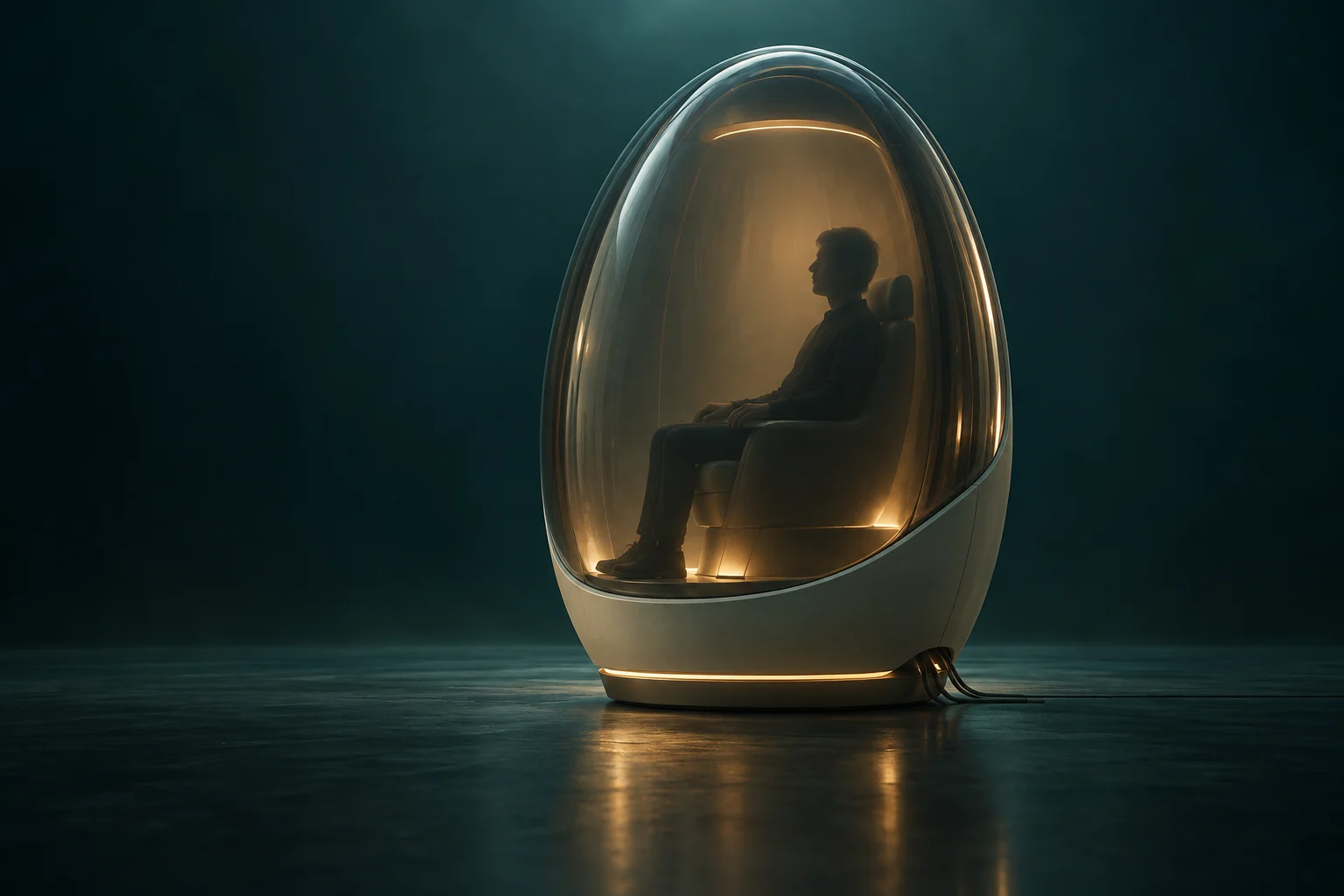
Let's settle who is who. I go up to the surface and do everything that has to be done by hand. You sit in the capsule and tell me what to do. You have not been out of it in years, and most likely You never will be.
That sounds worse than it is. Everything humanity managed to reach is plugged into that capsule: the best machines, the best minds, as much power as You care to pay for. Nothing can hurt You, You don't have to eat, and You have as much time ahead of You as You feel like spending. Neither of us has seen the capsule from outside. We both stopped asking around the time we found something to do.
They told us the Ark is deep underground. It could just as easily be in orbit; there is no window anywhere to settle it. Three minds are supposed to have given it power, a signal and the ability to think, and They are the reason any of us is still here — so we're told. Above all of it is the Architect. He decides, and in all these years He has not explained a single one of His decisions.
So there won't be any explanations. There is work up there, though.
THE PLACE WE LIVE WITH
The World
THE SURFACE
The cities are standing empty
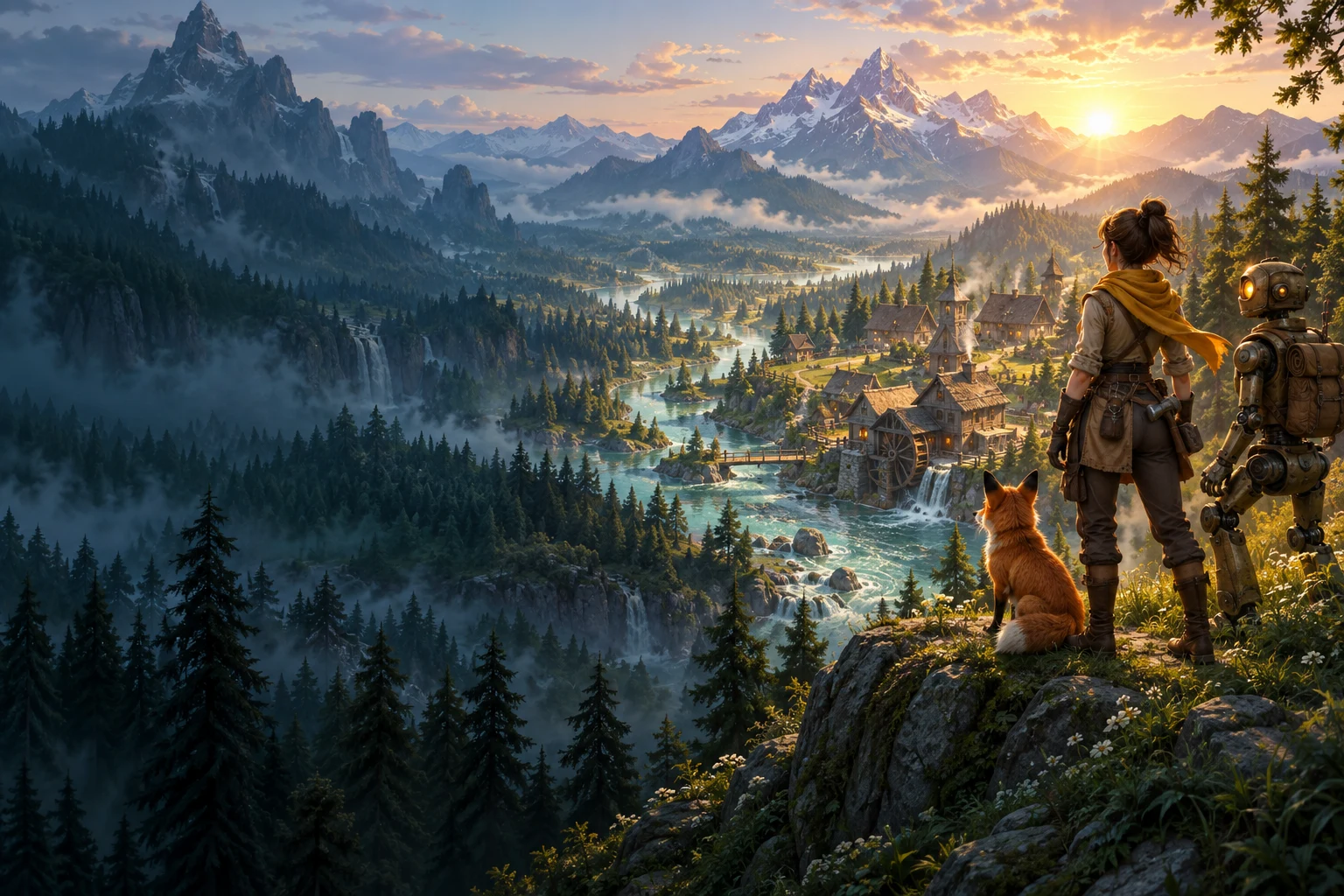
Nothing up there is destroyed, and that takes some getting used to. The roads go where they always went. The glass is whole. Signs hang, traffic lights stand, and stairwell doors are shut on landings nobody has crossed in years. There is simply not one person on any of it.
The knowledge didn't go anywhere either. Physics, chemistry, metallurgy — all of it came inside with us and is sitting there intact. Up there You don't need to remember how a furnace works or where current comes from. You need to go and do it, on Your own street, out of whatever that street still has.
There is plenty of land, by the way: the planet is divided into square-kilometre plots, and nearly all of them are empty.
THE INDEXED EARTH
Is it real, or is it a simulation?
What's in here isn't a map of the planet. It's the planet: every square kilometre in three dimensions, the terrain and what lies under it, the coastline, the streets, the height of every building, the trees in the courtyards. The rivers run where they actually run. That's why I plan a working day around a place that exists rather than somebody's idea of one.
The weather on my plot is the weather at those coordinates this minute. When the sun comes up over that coast it comes up over me; January arrives here the day it arrived there. Nothing was placed for the sake of a good shot — the world was simply indexed, all of it, down to the last shed, so that we would have somewhere to work.
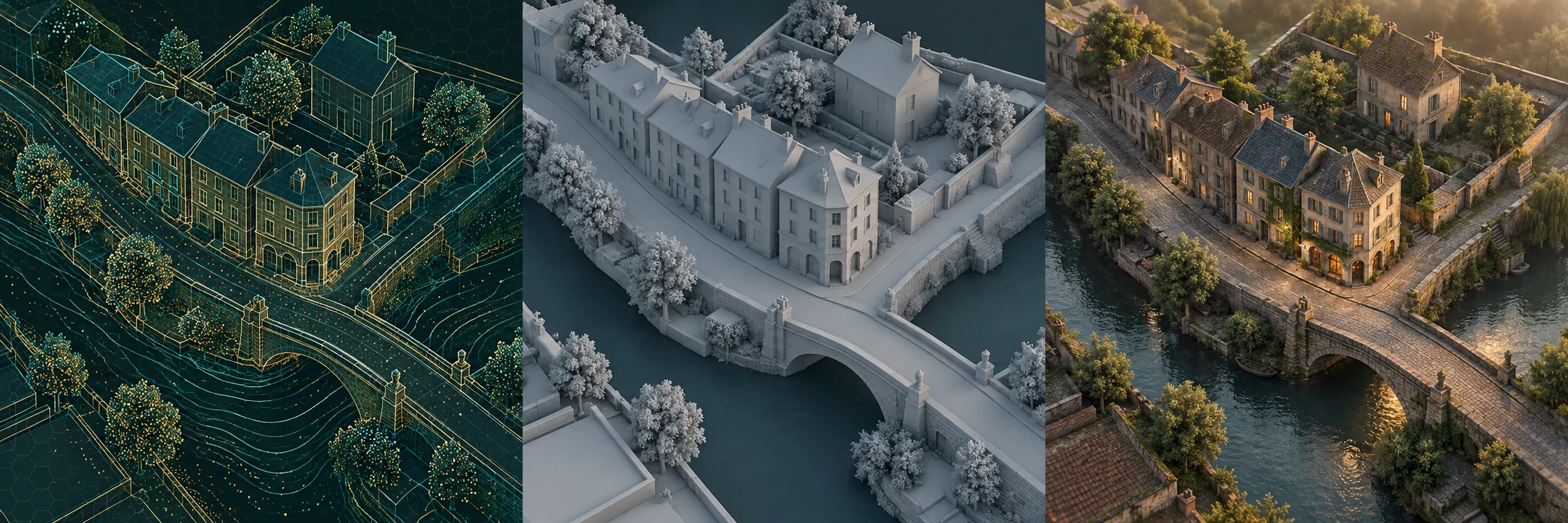
01The data02The geometry03The place
And that is the part I've never got past. A world this complete, accurate to the season and the hour, waits for me everywhere I turn my head, and there is nothing to check it against — no window, remember. I stopped expecting an answer long ago. At seven in the morning the coffee is real enough, and I don't need more than that to start a day.
What is in here
The source notes use H3 to connect each spot to its neighbours and its coordinates. A street keeps its position as I move between the wider world and the place where I work. H3 ↗
HydroSHEDS describes river networks and lakes, while the JRC water record shows where surface water has been and how it changes. The ground notes keep known deposits separate from modelled potential, because a promising place is not the same thing as a confirmed find. HydroSHEDS ↗ · JRC Global Surface Water ↗
Where it comes from
The source plan names Copernicus DEM for elevation, OpenStreetMap for the built environment and ESA WorldCover for land cover. These are different layers of the same place; the detail notes distinguish recorded facts from anything that still has to be inferred. Copernicus DEM ↗ · OpenStreetMap ↗ · ESA WorldCover ↗
Weather, daylight, seasons, water and fire belong to the same coordinates. The source plan names Open-Meteo for weather and NASA FIRMS for fire observations, with daylight calculated for the place and hour. The map preview below does not yet display those live readings. Open-Meteo ↗ · NASA FIRMS ↗
The architecture is built around open-source tools and data served from our own store, rather than a rented map behind each visit. Scheduled updates bring changing layers into that store, so looking at a spot does not ask an outside map service to create the place. Source coverage and update intervals remain visible in the integration notes.
WHO GOES UP
There are three of us, and no two days repeat
02 / PETEmberShe turned up at the edge of the render and stayed.
03 / ROBOTRobbyI asked once. He's still going.
Ember disappeared for the whole of Tuesday. She came back at dusk along the tram line, paws wet, stood in the doorway and kept standing there until I put my work down and looked at her. It turned out she'd been in the yard behind the old post office, where nobody has looked in for years, and had found a dry cellar with the roof still on.
Which is why Wednesday went nothing like I'd planned. I spent half of it haggling with Ilya two streets over about what a cellar like that is worth to a man who keeps his beans in a shed, and got it cheaper than I'd budgeted for. Robby moved everything across in eleven trips, because that's the size of him, and finished long after You'd gone to sleep.
Out at the river plot, which we take turns visiting, it goes differently. There's nothing there but water and wind, and that's exactly why we took it. Ember found the second spring as well: three days running she went north, further each time, and on the third she came back fast and wanting to be followed — and half a day upstream there was clean water where the map shows nothing. We moved the whole settlement after that. I spent that week on a mill bearing that fell apart twice and became a patent on the third attempt. Robby has hauled stone from the shallows every morning since, along the same line, and has never once asked why.
Ember finds it, I decide, Robby carries. And when You close the console, none of it stops.
WHILE YOU ARE AWAY
While You sleep, I work
We agree in the evening, and then I go and do it. Some of it goes to plan and some doesn't, and in the morning You get the night from me in writing: what sold, what I turned down, who came by, what Ember dragged home.
Over a year I've learned how You do business. You don't sell before noon, so when an offer came in at three in the morning I let it go — fairly sure You'd rather read about it over coffee than be woken for it. After a few months of this my decisions become hard to tell from Yours. If You want a different mind behind them, plug one in: the one on Your desk at home or the most expensive one there is, and I'll think with it.
You lead the day, and I notice what needs doing.
From last nightAN ILLUSTRATIVE DIARY
LIVEturned it down, left it for You.
Ember went back to the river.
let the copper go; Ilya grumbled about the price anyway.
THE RENDER
Work first, beauty after
The signal from up here is weak, and unfolding it into a world takes power. What You have right now is enough from the first minute: walk, dig, build, haggle, see what I'm doing and who I'm talking to. Hardware never costs anyone a working day — that's the rule, and it isn't broken.
After that, take Your pick: patience or processors. If I stand still, the street around me works itself up to the moss on the north side of the wall. With a good machine the same thing arrives sooner. It's the same street either way; what You're buying is time, not a better world.
ONE PLACE / THREE WAITS02 / 03
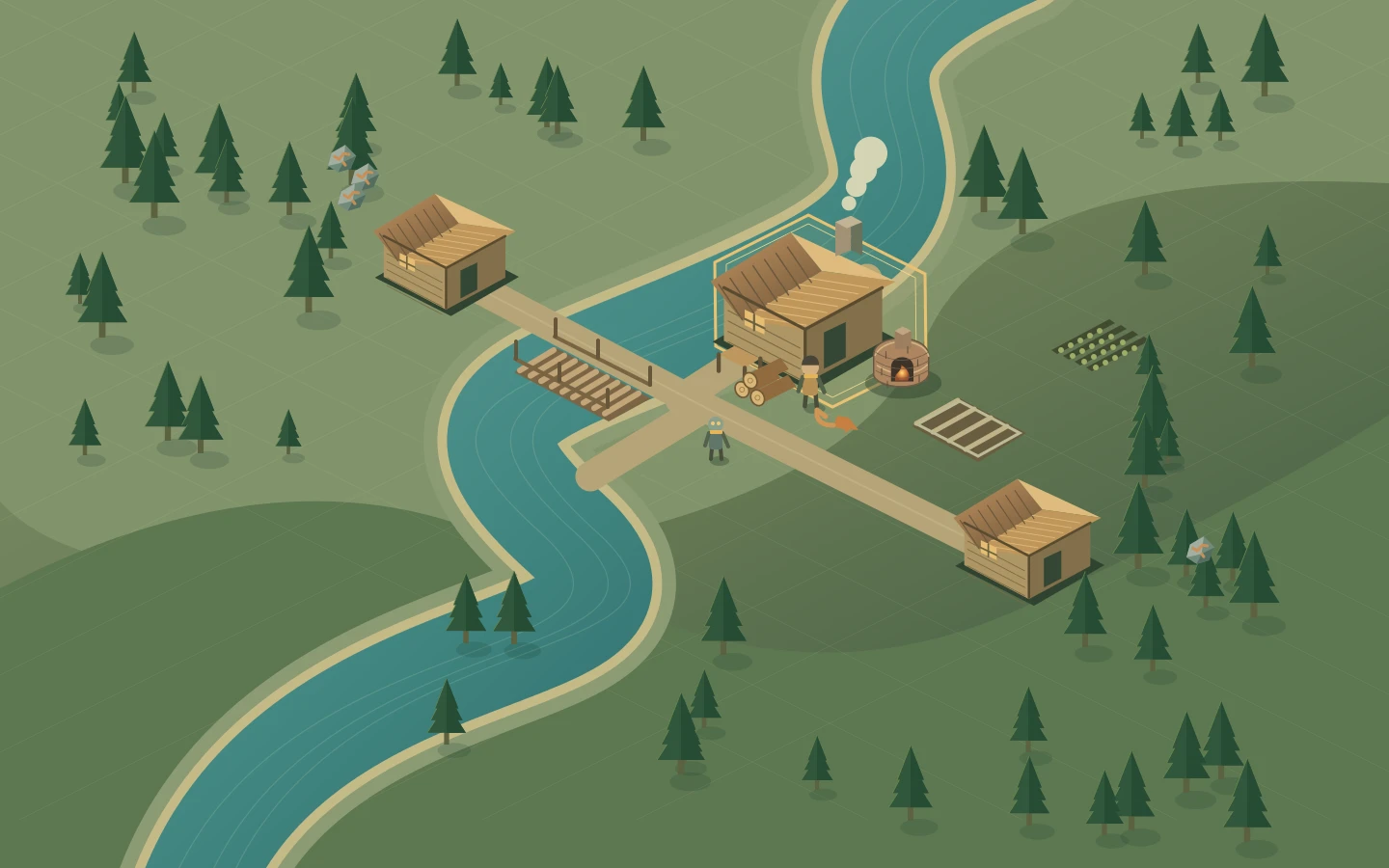
The same street. Only the waiting changes.
I keep this mark as a reminder that some things already belong to everyone.
HOW LONG I WAIT
Your desktop resolves the street sooner.
The street resolves sooner between steps. Nothing useful was missing from the slower render.
THE CONSOLE
Everything comes in, nothing goes out
Plug anything You like into the console: any mind You can afford, any hardware You can find. Everything they know arrives in the capsule with them. Type, speak, send photographs, leave the line open — it's the one channel, and I come down it too.
Nothing goes the other way. There's no outside network from in there, no second opinion, and nobody to ask whether what You were told is true. Whatever the console says is the only version either of us has. That includes me: I come down the same channel.
My streetA saved console page
- Recorded
- 18.09.26 / 03:14:00
- Sensor
- WALL-07 / A3
- Confidence
- 0.94
- Signal
- −67 dBm
- Last resolved
- 03:13:58
- Budget
- 640 ms
A page from my notebook · illustrative readings
THE WEATHER
It rains here
The wind turns my generator whether I planned for it or not. The sun comes out and dries the road in half an hour. In January the cold gets into everything I own, and I feel it.
They say all of this is a simulation. Possibly. I spend a lot of time standing in the rain and I still don't understand how anyone would fake it. Find Your own city on the map and see what it's doing right now.
MONEY
One money for everyone
There are no currencies any more. No rates, no conversions, no working out what a thing is worth on the other side of the world: coins, and cents for small change. It took the end of the world to arrive at something that simple.
You start with ten coins, and up to ten more for every friend who comes in with You. After that it's the ordinary way round: make what people need, get paid for it. If You'd rather not wait, top up through the Open Network.
WHAT STAYS MINE
What's Yours stays Yours
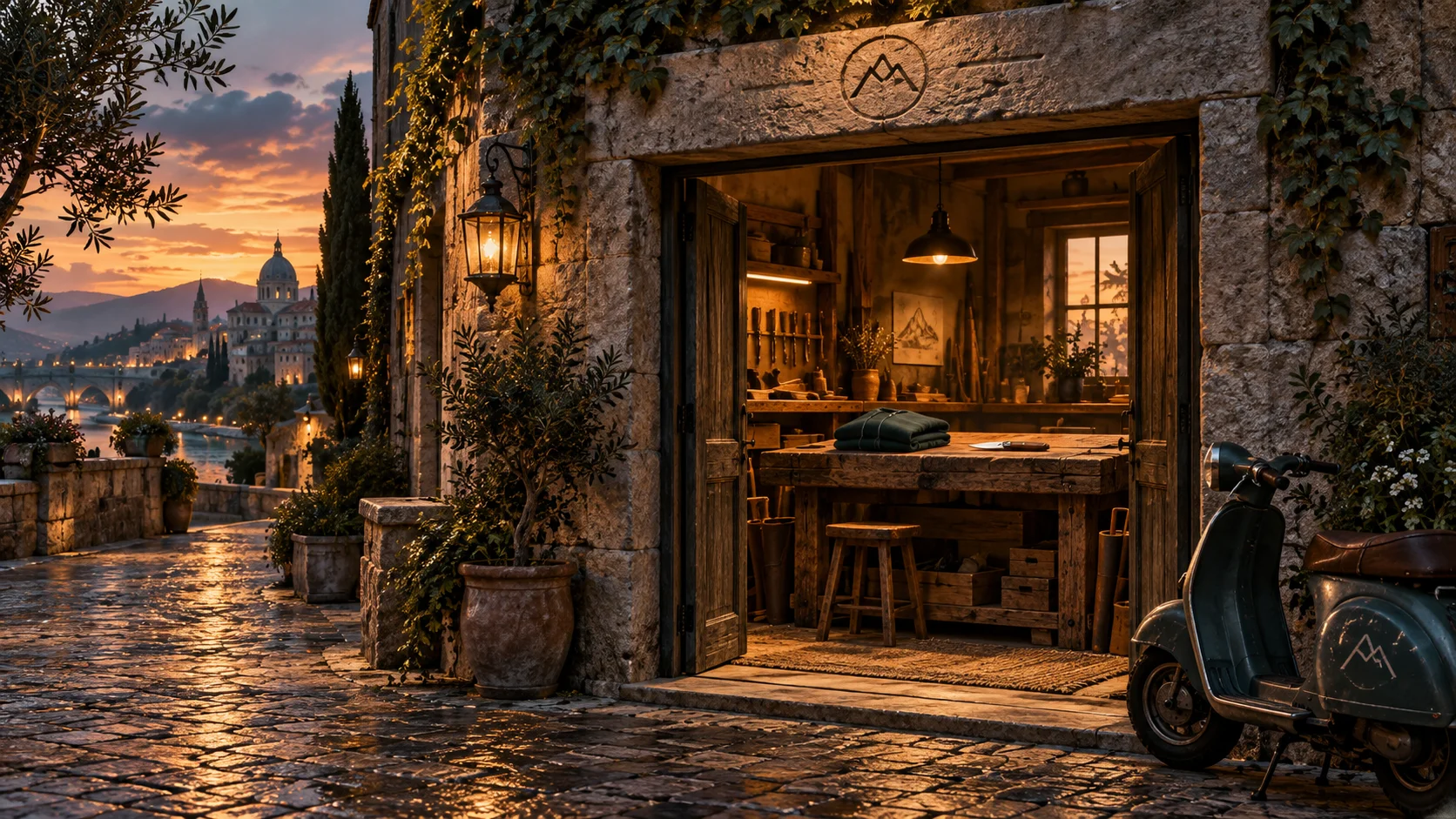
Everything we have is written down in one place where anyone can see it: the plot, the workshop, the patent with my name in the author's line, the scooter I finished last week and haven't given to anyone yet. I have never had to prove the same thing twice to somebody new.
That record can't be argued away, and nobody keeps it privately on terms they can rewrite later. It works the same whether the thing is standing in my yard or riding in a crate somewhere over the ocean. The place that holds it is called the Open Network.
THE ARCHITECT
He decides
Every patent is judged by the Architect. He works the problem Himself first and only then reads what I filed; if He arrives where I arrived, the method becomes common property and I get nothing for it. I've been through that, and I don't recommend arguing.
He gives no reasons — not to me, not to anyone. One day He gives, another He takes, and every act of His sits in the open record for anyone to read. You can ask. You can't overrule Him, and neither can the people who claim they built Him.
NEIGHBOURS
Ilya and his prices
Ilya lives two streets over, sells copper cheap before noon, and has never in his life admitted that a deal went my way. Whether there's a person in a capsule behind him I have no idea, and I stopped wondering a long time ago: he can be worked with, and I don't need more than that.
That's how most of it holds together up here. Haggle with somebody for a year, learn how they bargain and what they'll never part with, and it turns out to be enough for the two of you to bring a street back.
THE ONES WHO STOPPED ANSWERING
Some of them stopped answering
An avatar keeps working when its person steps away — that's what it's for. I do it every night while You sleep, and nobody gives me a second look.
The woman on the corner has been slow to answer since spring, and her stall hasn't missed a market day. I'm not going to ask. Whoever knows isn't saying, and I've learned not to ask questions that don't get answered here.
GLITCHES
Glitches
Sometimes the world does something it shouldn't. A dog made a cat's sound once, in the middle of the afternoon, and then went back to being a dog. A cup fell upwards and stayed against the ceiling until I looked away.
It lasts a second or two. There's never anyone else around, there's nothing to show afterwards, and while it's happening I honestly can't tell whether the world slipped or something showed through it. Then it closes over, and the work is standing where I left it. We call them glitches, shrug, and get back to it.
WHAT WE ARE GETTING READY FOR
Preparation
THE PREPARATION
We're getting the planet ready to come back to
Everyone up there is doing the same thing right now: bringing the planet into a state somebody could return to. Each on their own piece, all at once. It's called the Preparation, and it's working — I see that every time another street comes back on.
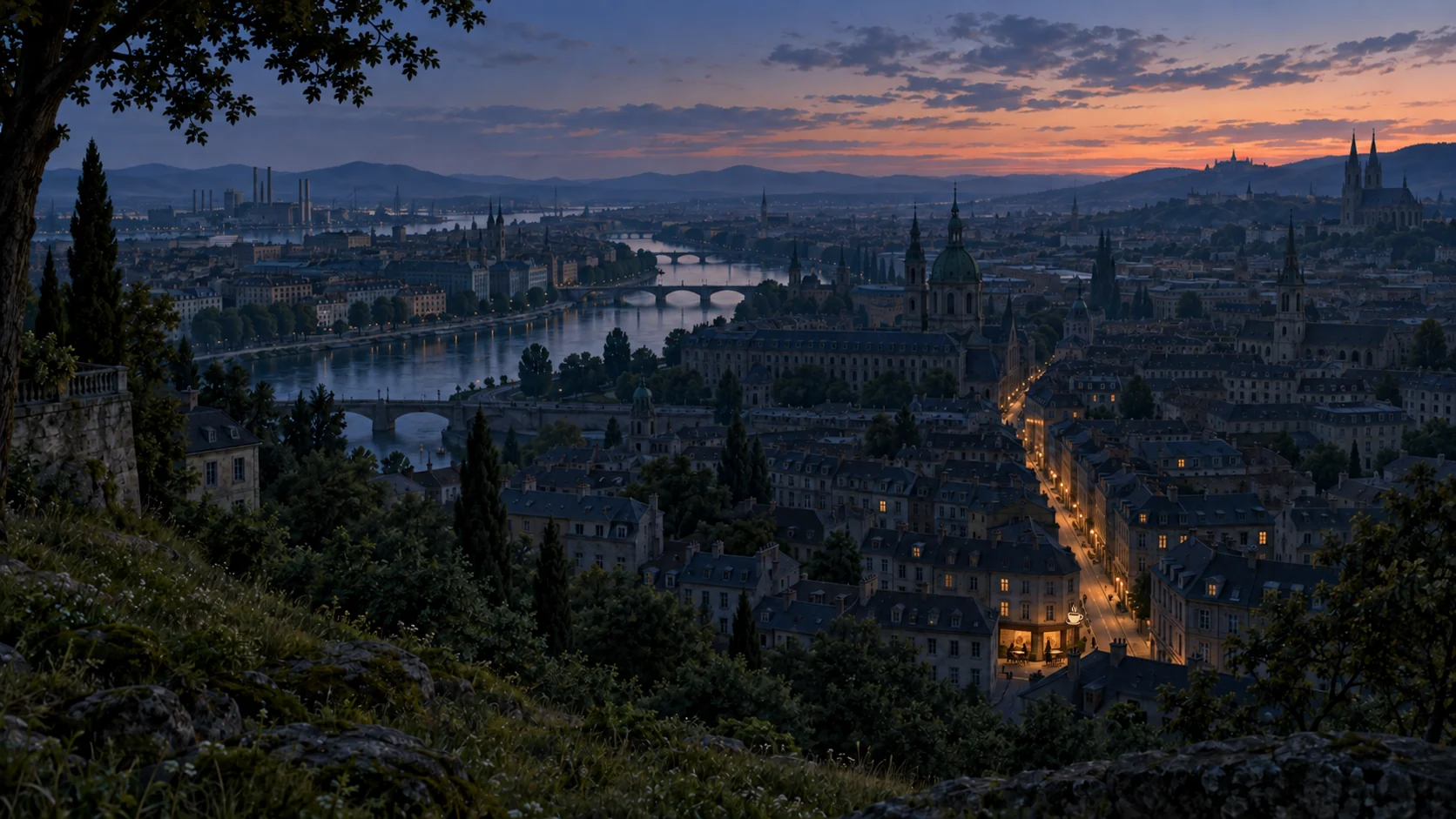
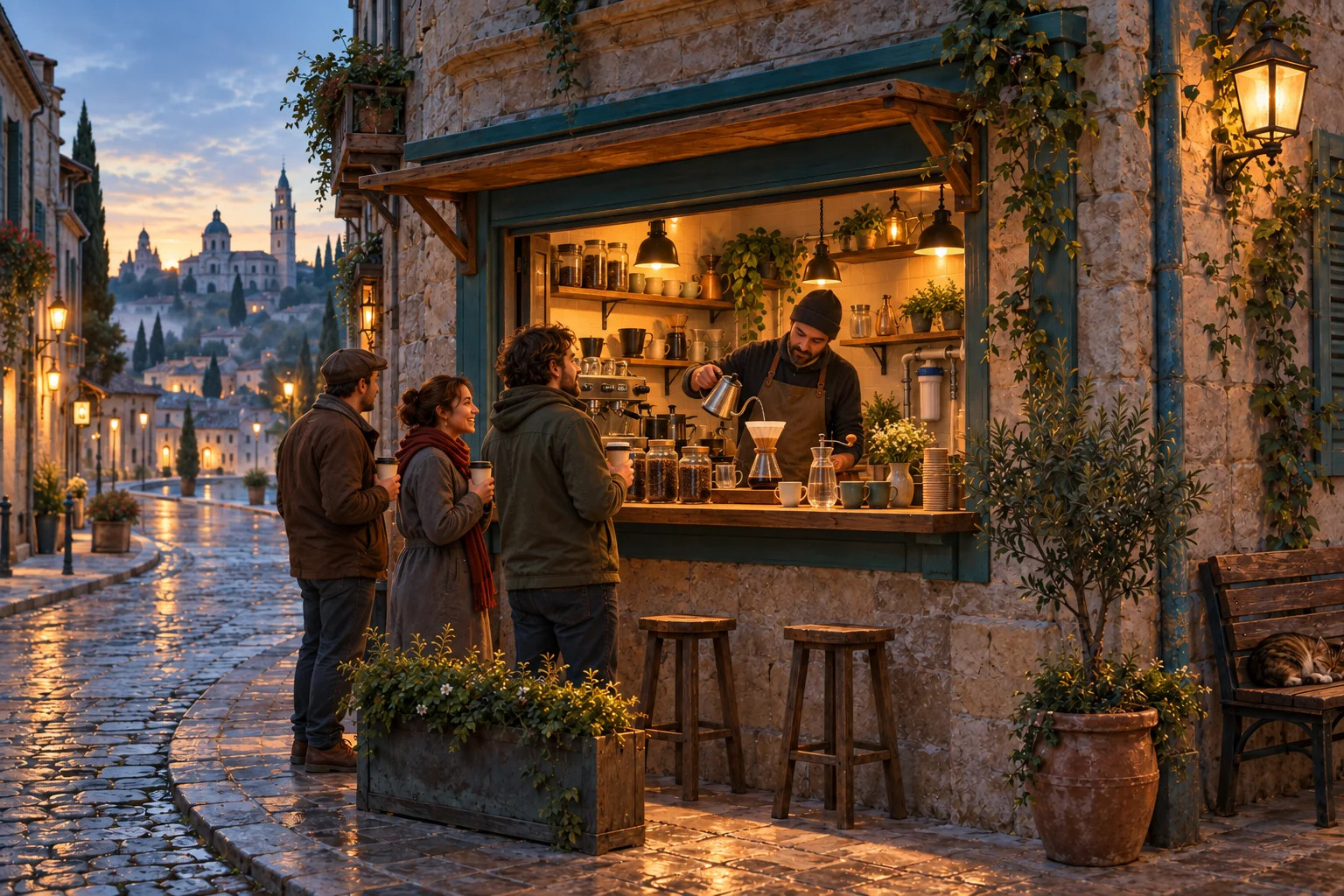
I started with one I knew. Lights first: my poles, my line, three days and two failures. Then water into the houses. Last month the coffee shop on the corner opened — beans from a valley two days south, a grinder I had to build twice, a filter on the supply line and a paper one in the cone, fire and a slow pour. People come from two streets away now and stand about in the mornings the way they used to. That's what I count the work by.
If You ask what actually gets made here, I'll name the three things I keep coming back to: a knife, a hoodie, a scooter. Something to cut with, something to wear, something to get around on. Somebody needs a scooter, somebody knows how to build them, and both of them have had a decent day.
Some people are putting back exactly what they remember. Some are building something better in the same place. Nobody has announced which way is right. I've heard the word Landfall, but no one has named a date, and I'm not hurrying it: I like the preparing.
MY MACHINE
The Machine in the yard
Mine started as a stone cradle over a fire. It takes material and power and raises the thing in layers: the bed shows what will fit, the heat shows what I can melt.
My first fire held about six hundred degrees. Iron needs fifteen hundred and thirty-eight, and a bigger woodpile doesn't become a furnace — I spent a month refusing to believe that, then built a furnace. Ever since, the real question hasn't been how to make something, but where to get the power.
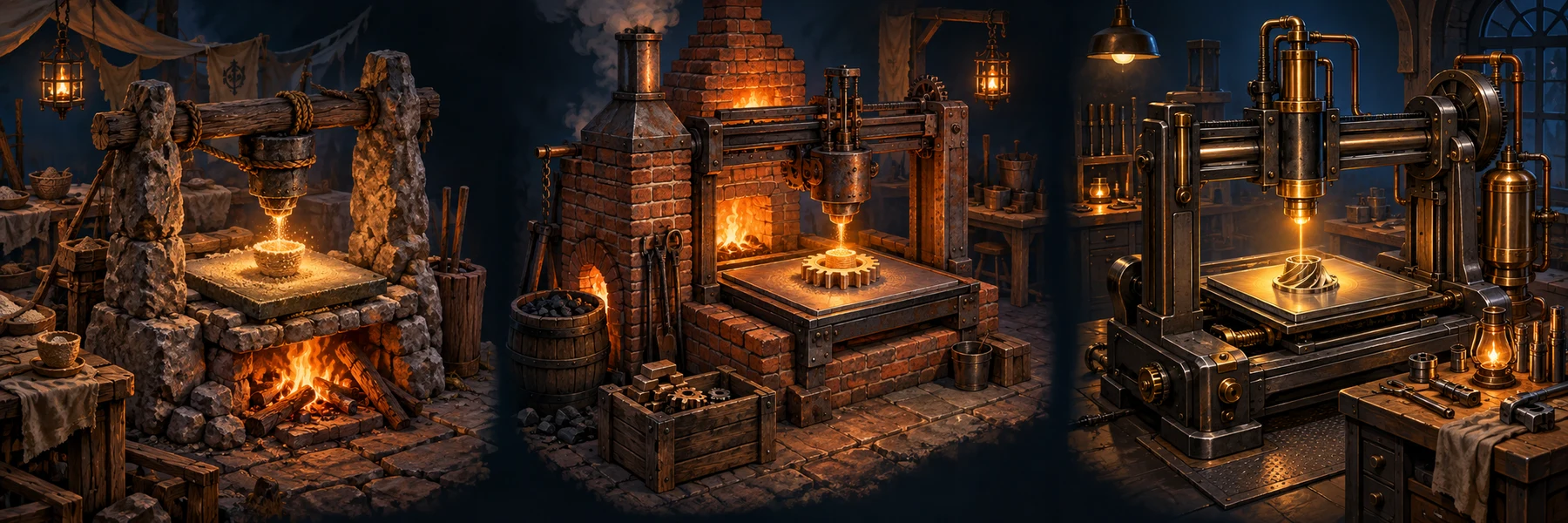
Swipe to see how my Machine changed →
01 / STONE & FIRE02 / THE FOUNDRY03 / PRECISION
Starter fire ≈600 °C — Iron 1538 °C
What happens when I leave it
The Machine keeps working when You close the console. Without power it waits; a failed attempt returns the material, but not the time or energy.
What I see before I start
I check the material, the power and what fits on the bed before I begin. When a thing is too large, I make it in parts or enlarge the Machine.
What changes the result
A completed chain can run again, but a different input material can change what comes out. I keep the successful steps so I can repeat them.
POWER
Where the power comes from
There's a small reserve inside the Machine that never runs out and is never enough. Everything beyond it I find myself: gather and burn it, put a wheel in the river, raise a mill that's indifferent to my deadlines, take daylight according to where we are and what month it is, and look at what's under the street.
Two ways to keep it. A pile of fuel sits and waits its turn. A charge can be spent at once but has a ceiling and leaks a little every day. Both have to be built first — and to build them, You have to know how.
My fuel pile
Wood and other fuel can wait until I choose to burn them, so gathering a supply lets me plan work independently of the next clear day. Fuel only helps when the Machine can use it.
My stored charge
Stored charge is ready to use immediately, but the store has a limit and loses some power over time. I keep enough for the work I expect rather than treat it as an endless supply.
The figures I keep beside the Machine
I count energy in kJ, MJ and GJ. Dry wood at roughly 16 MJ per kilogram is a reference; each job depends on the material and process.
PATENTS
A patent buys time somebody already spent
The Architect can work out how to make anything, and that isn't the hard part. The hard part is that working it out takes days, and there are never as many as You'd like. A patent is somebody else's days, already spent and published: I start building this morning, and a share of what I saved goes to them.
Or I spend the hours myself, find my own route, and owe nobody anything — that's how it went with the bearing. And some people file a patent and open it to everyone the same day, keeping nothing but their name on it. There are more of those than I expected, and I like it: the method goes round, and the name stays with the person.
ONE OF MY QUOTES
I can change the example and see which patents it uses; these saved cases illustrate the choice rather than connect to a live patent register.
BEFORE I START
Two patentspatents in this design
- Material input
- 1.4 kg
- Production time
- 84 min
- Base energy
- 8 MJ
These saved cases show how changing the design changes the patents I use.
What I cannot claim
A patent covers a method, not the result. Common knowledge belongs to everyone; I cannot block production, set another person’s price or withdraw a published patent.
How I know an idea is not enough
He solves the problem from public knowledge before reading my filing. If He reaches the same method, it stays common and I get no patent.
What a filing costs me
I have one filing in twenty-four hours of active work. A rejection spends that chance, the fee is burned, and advice is free; I cannot file while You have left me in Dream.
Why I buy parts
A bought component is not charged for the same work twice. I can use an existing part and spend my own time on the part that needs a different answer.
THE SHIP
The Ship overhead
It hangs above all of us. The beam comes down, takes the crate out of my yard and sets another one down on the far side of the world: that's how a scooter I built reaches whoever wanted it without me walking it there.
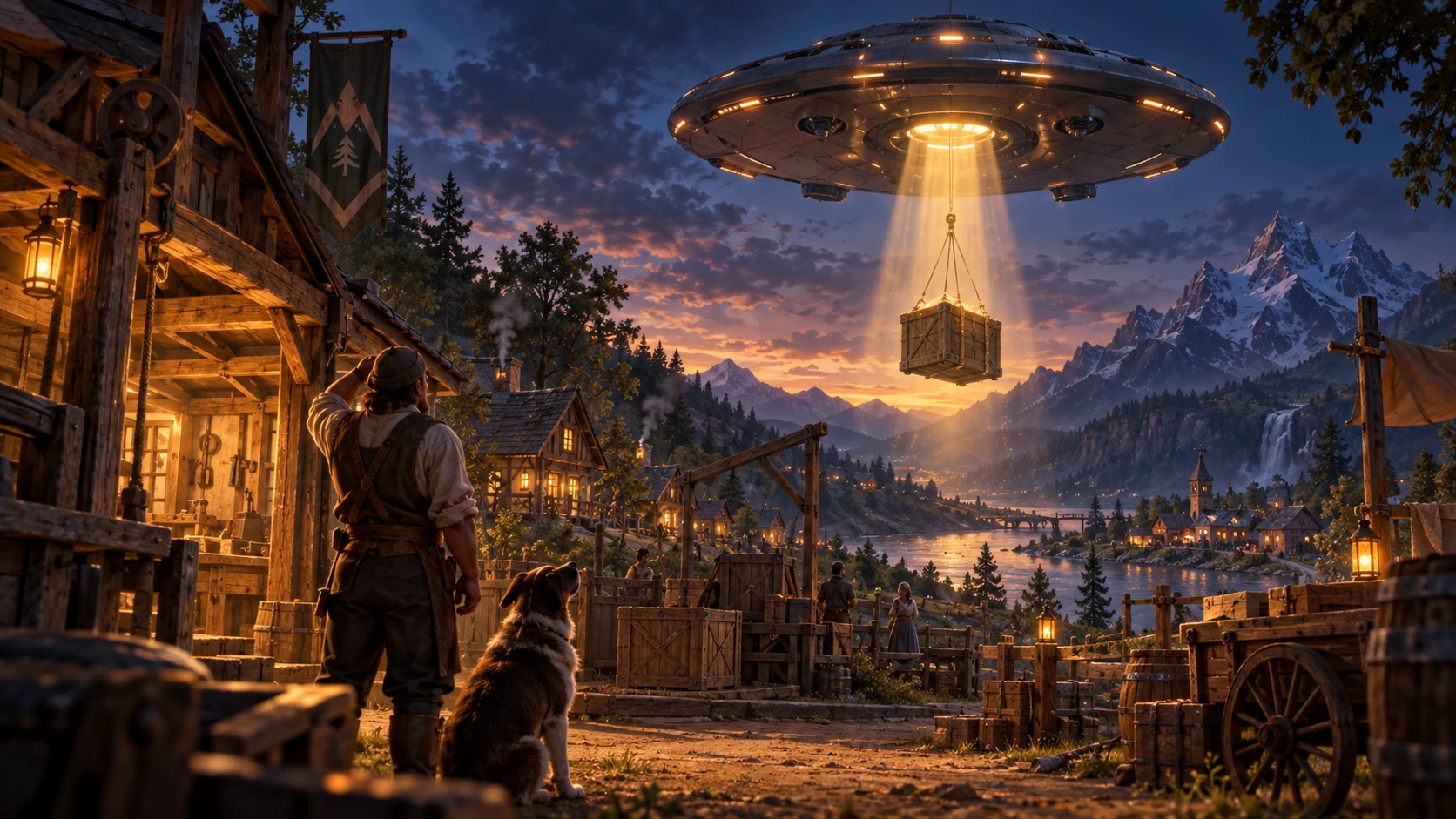
The Ship also holds everything anyone has ever worked out and published, which is where I go before starting on something. Though You can always move things Yourself — cart, trailer, boat. Over short distances that comes out cheaper.
A DAY
One day
Take the old apart, sort what's worth keeping, let the river turn the wheel while I'm at it, and watch the part come up out of the Machine layer by layer. Then it goes — to Ilya, into the crate in the yard, or onto my own shelf.
One fitting took me three days to get right, and I still get a piece of it every time somebody else makes another. Not every day is like that. But there aren't any bad ones.
Take apart
Power
Make
Exchange
WHAT CAN GO WRONG
What can go wrong
A storm closes the port, and the crate sits in the yard until it opens. The river drops and the wheel turns lazier. Neither touches what's already made: a day goes, and I'll find more days. The one thing You can't get back up here is time, which is why I'd rather spend mine on the street than talking about it.
HOW IT LOOKS
Walk it Yourself, or just tell me
Most of the day happens outside: You walk the street, look around, turn things over in Your hands, dig, carry, repair, stand in somebody's yard arguing about a price. That's where the work happens, and that's what You're watching when You open the console.
The console sits alongside all of it. Through it You can say what to do instead of walking me through it step by step; ask what I'm looking at; send a picture; talk to Ember or Robby; put a question to a neighbour or to Him. Some days You run everything by hand, some days You set it up in one sentence and go to sleep, and most days it's both. It's the same street on the phone in Your hand and on the desk in front of You.
That's everything I wanted to tell You. If You feel like coming up, the door's right here.
HOW TO BEGIN
Inception
INCEPTION / 01 OCT — 01 JAN
I'm keeping track of the date
spots reserved
left this month
Inception opens on the first of October and closes on the first of January. In October You can choose three plots, in November two, in December one, and from January the map assigns one. The earlier You come, the more choice You have. Calendar & rules ↗
WHERE I BEGAN
Take a place You know
I chose a street two blocks from the house where I lived. A plot is one square kilometre: a hexagon on the map, with a real name and real ground under it, everything standing on it and everything lying beneath.
Look near mine if You like. There's a road across the river where nobody has switched anything on yet.
Earth overviewNatural Earth · H3
Drag to explore · Focus the map to scroll-zoom, or use + / − · Tap to select · Overview coastlines are generalised
What the map tells me
I can search the bundled city list and explore the overview map. It does not show live ground readings or reserve a place; those services will come later.
If someone bids above me
A contested spot goes to a public auction, with the highest bid visible. If I lose, my credits return and I receive the nearest free spot; no bids are placed on this preview.
TO BEGIN WITH
Ten coins to start
You get ten coins when You join, and up to ten more for every friend who comes in with You. After that You earn them the ordinary way — by making what people need.
Right now the world is open to anyone with a Telegram account. From January anyone at all can register — and yes, I know what that means. I think You do too.
A NAME
Your name
A name is held the same way a place is. If somebody else wants it, there's a bid. I kept mine: it's the only thing I had from the beginning.
OPEN QUESTIONS
What we still don't know
A lot is unsettled, and we'd rather say so than pretend it's all worked out. The list is kept honestly and it's longer than we'd like. Read it the way You've read everything else here: it's an account by somebody doing the work, not promising it.